Abstract
The vast majority of high energy physics experiments rely on data acquisition and hardware-based trigger systems performing a number of stringent selections before storing data for offline analysis. The online reconstruction and selection performed at the trigger level are bound to the synchronous nature of the data acquisition system, resulting in a trade-off between the amount of data collected and the complexity of the online reconstruction performed. Exotic physics processes, such as long-lived and slow-moving particles, are rarely targeted by online triggers as they require complex and nonstandard online reconstruction, usually incompatible with the time constraints of most data acquisition systems. The online trigger selection can thus impact as one of the main limiting factors to the experimental reach for exotic signatures. Alternative data acquisition solutions based on the continuous and asynchronous processing of the stream of data from the detectors are therefore foreseeable as a way to extend the experimental physics reach. Trigger-less data readout systems, paired with efficient streaming data processing solutions, can provide a viable alternative. In this document, an end-to-end implementation of a fully trigger-less data acquisition and online data processing system is discussed. An easily scalable and deployable implementation of such an architecture is proposed, based on open-source distributed computing frameworks capable of performing asynchronous online processing of streaming data. The proposed schema can be suitable for deployment as a fully integrated data acquisition system for small-scale experimental apparatus, or to complement the trigger-based data acquisition systems of larger experiments. A muon telescope setup consisting of a set of gaseous detectors is used as the experimental development testbed in this work, and a fully integrated online processing pipeline deployed on cloud computing resources is implemented and described.

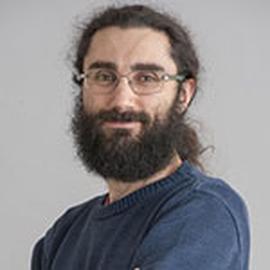
Jacopo Pazzini
Assistant Professor
Assistant Professor at University of Padova, working on Computing and Technological aspects of High Energy Physics.
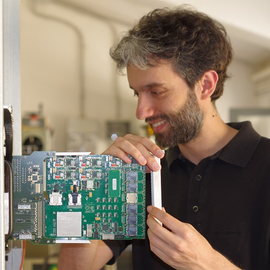
Andrea Triossi
Assistant Professor
Assistant Professor at University of Padua, Designer and developer of custom electronics for physics experiments
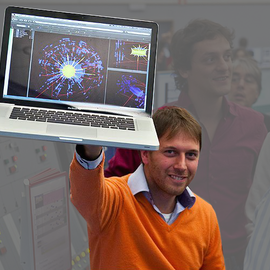
Marco Zanetti
Associated Professor
PhD at Univeristy of Padova, then research fellow at CERN and research associate at MIT. Since 2002 member of the CMS collaboration, spanning detector construction and commissioning, trigger and computing development and operations, Higgs discovery, searches for Dark Matter and New Physics. Now focused on advanced technologies and statistical methods to reduce bias in the analysis of complex datasets, in particular the developmet of a triggerless readout for HEP detectors and Machine Learning based anomaly detection algorithms.